
Can You Lower High FSH Levels Naturally?
If you’ve been told your FSH levels are high, you may be wondering whether there’s a way to lower them naturally — and what the result means for your chances of getting pregnant.
The short answer: FSH levels can fluctuate naturally, and elevated FSH does not necessarily mean pregnancy is impossible. The most useful approach is to understand what may be influencing your results, consider your overall reproductive health, and explore appropriate medical and complementary wellness options with your healthcare provider.
Rather than focusing only on lowering the number, it’s important to understand what your FSH result means, which additional tests may be helpful, and what options you can discuss with your fertility specialist.
Key Takeaways
- High FSH can indicate diminished ovarian reserve, but one result does not tell the whole story.
- Regular menstrual periods and elevated FSH levels can occur together.
- A comprehensive approach to reproductive wellness may include medical evaluation, healthy lifestyle choices, and complementary herbal support. The effects of herbal supplements on FSH levels and fertility outcomes require further research.
What Does High FSH Mean?
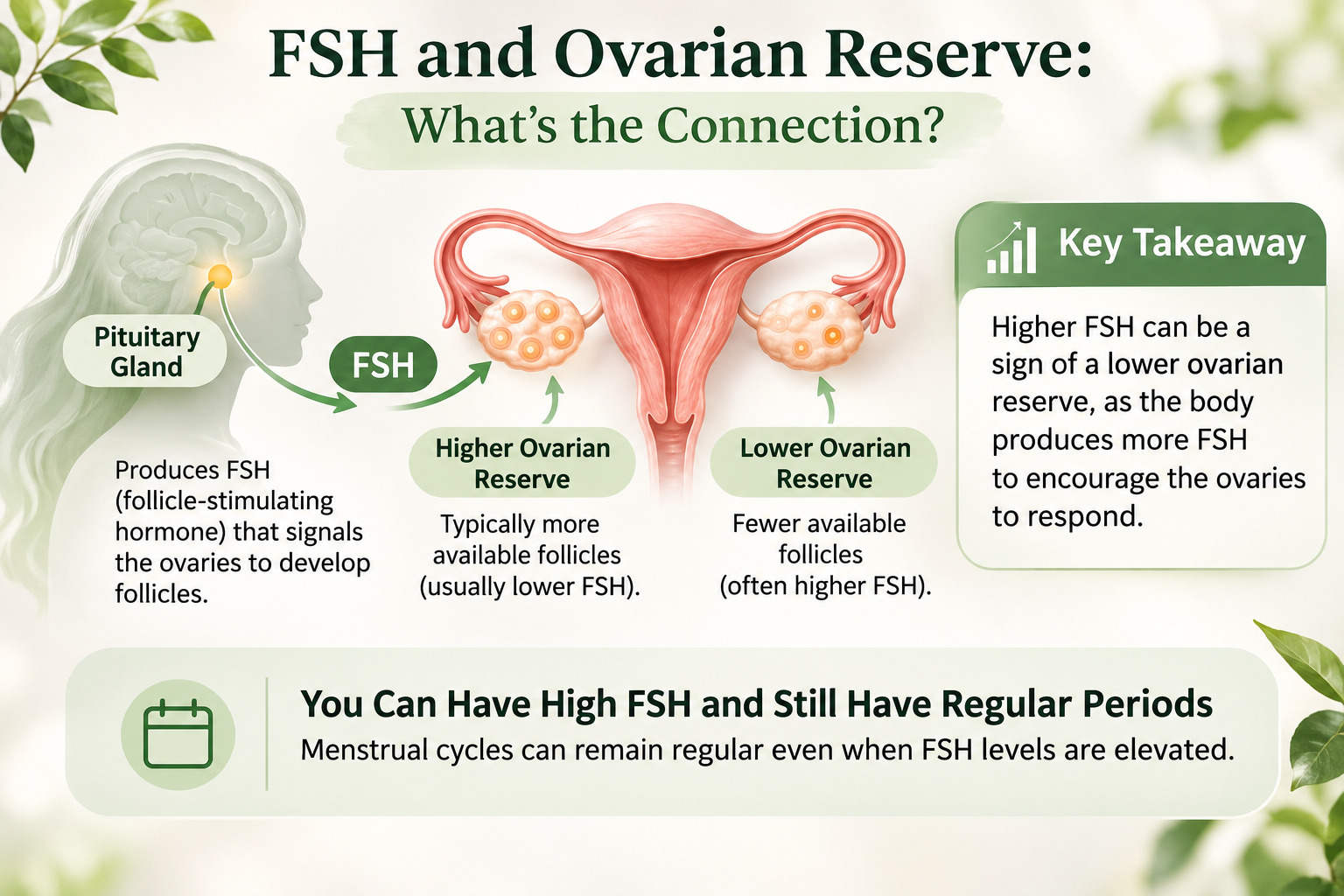
Follicle-stimulating hormone (FSH) is produced by the pituitary gland and helps regulate the menstrual cycle by stimulating the growth of ovarian follicles, which contain developing eggs.
When ovarian function declines, the body may produce more FSH to stimulate the ovaries. Elevated FSH can therefore be a sign of diminished ovarian reserve — a reduction in the number of remaining eggs.
However, a single high FSH result does not tell the whole story. Levels can vary between menstrual cycles, and results should be interpreted alongside your age, the timing of the test, and other fertility assessments.
High FSH does not necessarily mean you cannot conceive.
What Is Considered a High FSH Level?
FSH levels are commonly measured early in the menstrual cycle, typically on days 2–4. What counts as an elevated result depends on the laboratory’s reference range, your age, the timing of the test, and other hormone levels.
A single FSH measurement does not provide a complete assessment of ovarian reserve. Your healthcare provider may interpret it alongside estradiol, AMH, and antral follicle count.
The important question is not just whether your FSH is high, but what the result means in the context of your overall fertility evaluation.
Can You Have High FSH Levels and Still Have Regular Periods?
Yes. You can have elevated FSH levels and still have regular menstrual cycles.
Regular periods generally suggest that ovulation may still be occurring, but they do not necessarily mean that ovarian reserve is normal.
Changes in ovarian reserve can begin years before menstrual cycles become irregular. This is why some women discover elevated FSH during fertility testing, even though their periods have not changed.
If your FSH is elevated but your cycles are regular, your healthcare provider may recommend additional testing to better understand your ovarian function.
The key takeaway: Regular periods and high FSH are not mutually exclusive, and neither finding alone determines your chances of pregnancy.
What Tests Should You Consider Alongside FSH?
FSH is only one part of a fertility assessment. Your healthcare provider may recommend additional tests to better understand your ovarian reserve.
- AMH (Anti-Müllerian Hormone): Helps estimate ovarian reserve and may provide useful information about the expected response to ovarian stimulation.
- Antral Follicle Count (AFC): An ultrasound examination that counts small follicles in the ovaries.
- Estradiol (E2): Often measured alongside FSH early in the menstrual cycle, since elevated estradiol can affect how FSH results are interpreted.
FSH and estradiol are typically assessed on days 2–4 of the menstrual cycle.
No single test can reliably predict whether you will become pregnant naturally. Your age, medical history, and overall fertility evaluation are also important.
FSH vs. AMH vs. AFC: What’s the Difference?
FSH
Hormone signaling
Elevated early-cycle FSH may indicate diminished ovarian reserve. Levels can vary between cycles.
AMH
Ovarian reserve marker
Helps assess ovarian reserve and predict ovarian response to stimulation.
AFC
Ultrasound follicle count
Counts small visible ovarian follicles and helps estimate response to stimulation.
Source: American Society for Reproductive Medicine (ASRM) – Ovarian Reserve Testing
How to Lower FSH Levels Naturally: What Does the Evidence Say?
If you’re looking for ways to lower high FSH levels, it’s important to distinguish between changing a hormone measurement and improving ovarian function.
Research into natural and complementary approaches to reproductive health is ongoing. Herbal medicine has a long history of traditional use, but clinical evidence regarding its effects on FSH levels, ovarian reserve, and pregnancy outcomes remains limited.
A balanced approach may combine medical guidance, healthy lifestyle habits, and complementary wellness practices, with appropriate professional supervision.
Practical steps that may support your overall reproductive wellness include:
- Avoid smoking: Smoking is associated with reduced fertility and earlier menopause.
- Eat a balanced diet: Choose a varied diet that provides essential nutrients.
- Maintain healthy habits: Prioritize regular physical activity, adequate sleep, and management of existing health conditions.
- Discuss complementary support: If you’re considering herbal supplements, review them with your healthcare provider, particularly during fertility treatment.
The goal is to take an informed, personalized approach to your reproductive health, combining appropriate medical care with supportive wellness practices.
What Should You Do After a High FSH Result?
A high FSH result can feel concerning, but it is not a diagnosis of infertility. The most useful next step is to understand what the result means in your individual circumstances.
Here are four practical steps:
- Review your results with a fertility specialist. Ask how your FSH level relates to your age, menstrual cycle, and medical history.
- Discuss additional testing. AMH, estradiol, and antral follicle count may help provide a clearer picture.
- Consider your reproductive timeline. If you’re over 35 or planning fertility treatment, ask whether an earlier evaluation is appropriate.
- Discuss your options. Depending on your circumstances, your specialist can explain whether further evaluation or fertility treatment makes sense.
Remember: High FSH is one piece of information, not a final answer about your fertility.
Medical reference: American Society for Reproductive Medicine (ASRM) – Fertility Evaluation of Infertile Women (2026)
Questions to Ask Your Fertility Specialist
- What does my FSH result mean for my age?
- Should I also test AMH, estradiol, or antral follicle count?
- Does having regular periods change how we interpret my results?
- Should I consider fertility treatment now, or is further evaluation needed?
Frequently Asked Questions About High FSH
Can high FSH levels return to normal?
FSH levels can fluctuate between menstrual cycles, and a later test may show a lower result. However, a lower reading does not necessarily indicate improved ovarian reserve.
Can you get pregnant with high FSH?
Yes, pregnancy may still be possible with elevated FSH. Your chances depend on several factors, particularly age and overall reproductive health. FSH alone cannot determine whether you can conceive.
Does high FSH always mean menopause?
No. Elevated FSH can occur before menopause and does not establish a menopause diagnosis on its own. Age, menstrual history, symptoms, and other clinical findings matter.
Final Thoughts
High FSH is one piece of your fertility picture, not a final answer about your ability to conceive. Understanding your results, considering additional tests, and discussing your options with a fertility specialist can help you make informed decisions.
For more information on fertility, ovarian health, and reproductive wellness, explore our Fertility Resources center.
Exploring Herbal Wellness Support?
Women’s FSH Support is a traditional herbal formula designed for women seeking complementary reproductive wellness support. Research into the effects of herbal supplements on FSH levels and fertility outcomes is ongoing, and clinical evidence remains limited. Consult your healthcare provider before use, particularly during fertility treatment.